
Analysis
Exemptions as a Competition Policy Tool in South Africa
September 14, 2026
Exemptions as a Competition Policy ToolCompetition Policy
I. Introduction
The abuse of market power, along with several other anti-competitive horizontal and vertical practices, is prohibited by the South African Competition Act (“the Act”). While much of the literature emphasises the role of public interest considerations in merger control in South Africa3, this paper examines another competition tool, i.e. exemptions, which can similarly advance public interest objectives such as promotion of exports, growth and/or the transformation of an industry.
Section 10 of the Act makes provisions for firms to apply for an exemption from several prohibited practices, based on either public interest or intellectual property grounds. In this note we show that a majority of such exemptions have been granted on public interest grounds. More specifically, they were granted to support the stability, growth, and/or transformation of an industry. This illustrates that such exemptions, aimed towards alleviating tensions between competition policy and other economic development policies, in particular industrial policy, have become a frequently used tool for South Africa’s competition authorities.
The Competition Amendment Act (2018) introduced a new clause to Section 10 (Section 10(10)), granting the Minister of Trade, Industry and Competition the power to issue regulations exempting a category of agreements or practices from the application of the Act. As we show below, this clause has paved the way for a new wave of Block Exemptions designed to support the growth and transformation of certain industries. Recent examples include the Energy Users Block Exemption (Amended in 2026) and the Draft Interim Block Exemption for Tariffs Determination in the Healthcare Sector (2025), which is currently open for public comment prior to possible finalization. The competition policy tool of Block Exemptions was also used to respond to the recent increases in tariffs announced by the US in April 2025.4
This note first explores exemptions as a general competition policy tool to support industrial policy and economic development in South Africa. It then discusses the more recent reliance on Block Exemptions to support certain sectors, expanding on the Block Exemptions for the Promotion of Exports to illustrate how Block Exemptions can be used to respond to a crisis.
II. Role and Purpose of Exemptions
The Act not only seeks to achieve conventional goals such as the preservation and promotion of market competition, but also explicitly features non-competition, or “public interest”, objectives. These broadly focus on the development of the economy, the promotion of employment, expanding exports, opportunities for small and medium-sized enterprises, and facilitating a broader and more inclusive distribution of ownership and participation in the economy. These are pertinent goals given South Africa’s economic context, characterised by the legacy of apartheid, low growth, high levels of poverty, and persistently high unemployment (32.1% in mid-2025).5
The Act allows the Competition Commission (“Commission”) to grant three different types of exemptions, permitting firms to engage in agreements or conduct that would otherwise be prohibited by Chapter 2 of the Act.6 The three types of exemptions that can be granted by the Commission are: (1) public interest exemptions; (2) intellectual property exemptions; and (3) professional association exemptions.
Public interest exemptions can take two forms, individual and block exemptions, the latter becoming more common in recent years. In respect of the former, firms, or an association of firms, may apply to the Commission for an exemption from the Act, which may be granted (conditionally or unconditionally) for a specified period, if the conduct in question contributes to any of the following objectives (listed in section 10(3)(b):7
- The promotion or maintenance of exports.
- The effective entry, participation, and/or expansion within a market by medium and micro-sized enterprises (“SMMEs”) and firms owned or controlled by historically disadvantaged persons (“HDPs”).
- Change in productive capacity necessary to stop decline in an industry.
- The stability, growth and/or transformation of an industry.
- Competitiveness and efficiency gains that promote employment or industrial expansion.
The last objective (v) was introduced by the Amendment Act (2018), which was apparently aimed at strengthening the industrial policy angle. This, in combination with the new Section 10(10), granting the Minister increased powers to implement an exemption, led to an increase in Block Exemptions. Block exemptions, contrary to the individual exemptions, are blanket authorizations issued by the Commission that automatically apply to a defined category of agreements or firms. Where individual exemptions are based on firm-specific applications, block exemptions predefine permitted conduct aligned with public interest objectives. Herewith, such exemptions serve as a broader policy tool to address sector-wide issues and are often used to balance competition policy and industrial policy goals.
III. Brief Summary of Exemptions Granted in South Africa
Based on our review of official communications, including Government Gazettes and public notices, we identified at least 45 exemptions granted since 2000, that correspond to 29 unique instances (some with renewed extensions), though this may not be exhaustive. Of these, all but one appear to have been granted on public interest grounds, with a single exemption granted on intellectual property grounds in 2004.
Figure 1 below provides a breakdown of the 28 unique public interest exemptions by their stated objectives (including both individual and block exemptions). Specifically: 10 were granted to support the stability, growth, and/or transformation of an industry; 9 to promote or maintain exports; 7 to facilitate effective entry, participation, or expansion in a market SMMEs or firms owned or controlled by HDPs; 1 to enhance competitiveness; 1 addressed both competitiveness and SMME/HDP participation; and 1 uniquely aimed at preventing critical shortages of essential goods within the country.
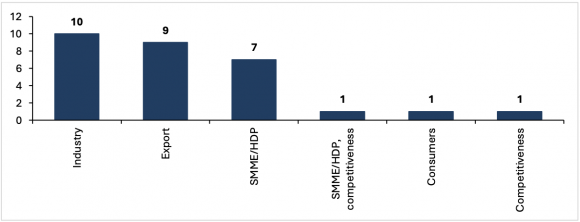
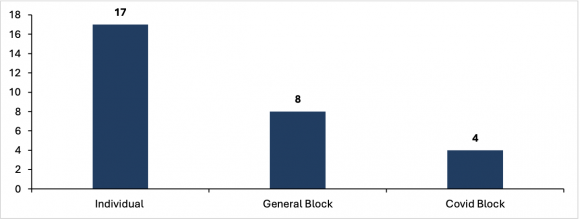
Figure 2 presents a breakdown of unique public interest exemptions granted, categorised by individual firm exemptions, general block exemptions, and COVID-19-specific block exemptions.
The COVID-19 block exemptions, all of which include “Covid” in their name, were issued in 2020 to support industries under strain from the nationwide lockdown. These included exemptions for the healthcare sector (to manage the pandemic), the banking and retail property sectors (to support financially distressed individuals and businesses), and the hospitality sector (to accommodate quarantine requirements). In addition, in 2021, an additional, related Block Exemption (albeit not bearing “Covid” in its name) was introduced to prevent shortages of essential goods. These emergency measures appear to have paved the way for broader block exemptions introduced in later years aimed at supporting businesses as part of broader public interest and industrial policy goals.
The first post COVID-19 general block exemption was seemingly granted in 2023 to energy users, in response to the ongoing energy crisis in South Africa, aiming to stabilise the sector. This was followed in 2024 by a broad exemption for certain categories of agreements or practices among SMMEs, and further exemptions in 2025 targeting sectors such as energy users, implementation of the Sugar Master Plan, public infrastructure development (including ports, rail, and roads), export promotion, and healthcare tariff determination.
IV. Block Exemption for the Promotion of Exports
Block Exemptions are a relatively new instrument in South Africa, but their use has been steadily increasing. The following section examines their purpose, design, and limitations, focusing specifically on the Block Exemption for the Promotion of Exports, implemented on 12 December 2025.8
By way of context, in 2024 the United States accounted for 7.69% of South African Exports.9 As indicated in Figure 3 below, these exports were concentrated primarily in precious metals, vehicles, and iron and steel products.
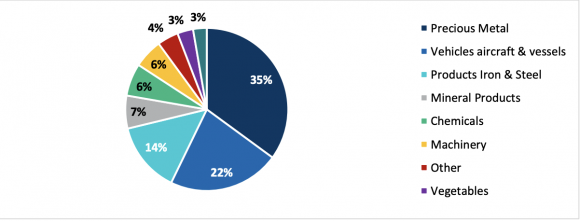
In April 2025 the United States effectively announced the imposition of a 30% tariff on South African exports. While precious metals were largely exempt, the incidence of the tariffs largely fell on manufactured goods.10
Against this backdrop, and other trade barriers globally, the Block Exemption for the Promotion of Exports was introduced, with a five year duration.11 Following its introduction, the Commission announced that the exemption “aims to mitigate the economic impact of global tariff changes, support export diversification initiatives, and strengthen the resilience and growth of South African exports”.12
At its core, the exemption allows collaboration between competitors, customers, and suppliers in South Africa involved in exporting, thus allowing conduct that would otherwise constitute prohibited horizontal or vertical practices under The Act. In particular, it allows for co-ordination aimed at achieving economies of scale and efficiencies in export markets including: sharing or offsetting landed costs; coordinating joint financing and the development of export-related infrastructure; sharing information relating to import requirements and product regulations; and coordination of shipment, storage, freight, insurance, and other export-related logistics.
These measures are intended to reduce costs and enhance the competitiveness of South African exports across all international markets, thereby mitigating the adverse effects of the recent imposition of United States tariffs, which would otherwise diminish the attractiveness of those exports (particularly in the United States).
The exemption does not however allow for market allocation, collusive tendering, resale price maintenance, or for a merger transaction that would otherwise be considered anti-competitive. Firms seeking to rely on the exemption must also first obtain confirmation from the Commission that the proposed conduct falls within the scope of the exemption.
While South Africa at the time of the tariff crisis (April 2025) had some experience with Block Exemptions as an industrial policy tool, these export block exemptions cover multiple industrial sectors and can affect a large part of the economy (that are exposed to exports). While there was a sufficient period for comments between the publication of the Draft Exemptions in August 2025 and the final exemptions in December 2025, it is unclear whether these ambitious regulations will have a major impact on the promotion of exports.
One issue is that the language around the scope of the permissible conduct is not always clear. Firms must approach the Commission for confirmation, which can be time-consuming. Regulatory and administrative burdens may discourage cooperation, particularly given the temporary five-year duration, which can create uncertainty around funding and the long-term viability of cooperative ventures.
Further, the exemption addresses only domestic collaboration and cannot remove external trade barriers such as tariffs, quotas, or foreign regulatory restrictions. As such, it cannot serve as the sole policy response and should be complemented by broader trade and industrial policies.
Nevertheless, the fairly swift response by the Minister of Trade, Industry and Competition, under the new section 10 (10) of the Act, did afford South Africa a valuable opportunity to use competition law to support exporters. This response can form an important tool, amongst other policy responses, especially if exporters make the most of this opportunity.
V. Conclusions
While a number of exemptions for firms have been granted over the years, the recent increase in Block Exemptions is an important change in the interplay between competition and industrial policy. This seems to be a recognition that certain practices that may seem anti-competitive, may be necessary to promote and stimulate inclusive growth in certain sectors. Block Exemptions were successfully used as a policy tool during the Covid-19 crisis. Post Covid-19 it has increasingly been used to support certain sectors, and most recently to support all exporters in response to the international tariff crisis. While some of the Draft Block Exemptions, like the Draft Interim Block Exemption for Tariffs Determination in the Healthcare Sector (published during February 2024 and not yet implemented), take a long time to finalise, we will probably see increased use of Block Exemptions as a policy tool to support industrial policy and economic growth in South Africa.
- Extraordinary Professor, Department of Economics, Stellenbosch University and Affiliate at FTI Consulting.
- Director, FTI Consulting.
- Changole, P., & Boshoff, W. H. (2022), Non-competition Goals and Their Impact on South African Merger Control: An Empirical Analysis. Review of Industrial Organization, 60(3), 361–401. https://doi.org/10.1007/s11151-022-09856-z.
- Dowing, T. (2025), ‘Liberation day’: What are tariffs and why do they matter. The Guardian. 3 April 2025.
- StatsSA. (2024), Quarterly Labour Force Survey: Quarter 3: 2025.
- Republic of South Africa. (1998), Competition Act 89 of 1998 (as amended).
- Republic of South Africa. (1998), Competition Act 89 of 1998 (as amended).
- South Africa Government Gazette. (2025). No 53822, p.354. 12 December. Block Exemption for the Promotion of Exports, 2025.
- South African Revenue Service. (2024), 2024 trade statistics. Available via the data portal.
- Trade & Industrial Policy Strategies. (2025). Fact sheet: Implications of US tariffs for South Africa.
- South Africa Government Gazette. (2025). No 53822, p.354. 12 December. Block Exemption for the Promotion of Exports, 2025.
- Competition Commission. (2026). BLOCK EXEMPTION FOR THE PROMOTION OF EXPORTS: Media Announcement.
Notes 1–12By Nicola Theron & Timothy Evans